Poal Institute · Barcelona
Ultrasound-guided barbotage for calcific tendinopathy.
A minimally invasive treatment to assess and treat tendon calcifications with real-time musculoskeletal ultrasound.
Calcifying tendinopathy
When a calcification limits your movement.
Calcifying tendinopathy occurs when calcium deposits form in a tendon. It can cause pain, swelling, and difficulty moving the joint; It is especially common in the shoulder.
Not all shoulder pain is due to calcification, nor do all calcifications require the same treatment. At Instituto Poal we carry out a clinical and ultrasound assessment to decide the most appropriate approach in each case. He bubbling, also known as barbotage, can also be called ultrasound-guided lavage of calcifications when it affects the shoulder.
Ultrasound-guided procedure
What is barbotage?
It is a percutaneous technique aimed at fragmenting and washing or aspirating the calcium deposit from the tendon. Ultrasound makes it possible to identify calcification, plan access and visualize the treated structures at all times.
1. Assess
Ultrasound studies calcification and the condition of the tendon.
2. Treat
Each step is performed with real-time images for precise performance.
3. Follow-up
The clinical and ultrasound follow-up required by each patient is scheduled.
Musculoskeletal ultrasound
Ultrasound guides every decision.
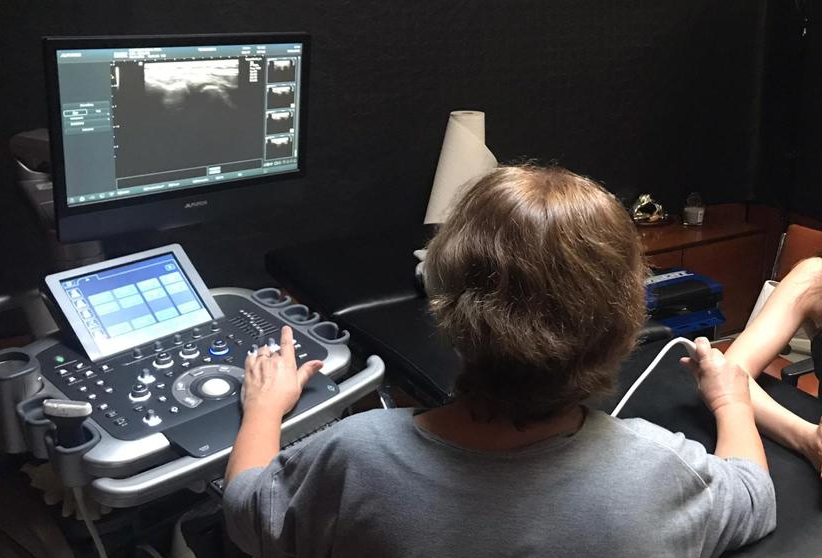
Ultrasound is part of the assessment, decision making and follow-up. This experience allows the tendon and nearby structures to be examined, calcification assessed, and procedures performed with continuous visual monitoring.
Accurate assessment
Dynamic and detailed images of the tendon, calcification and surrounding tissues.
Ultrasound-guided treatment
Real-time visualization during the procedure to guide each step.
Individualized follow-up
Control of evolution and coordination with physiotherapy when indicated.
Image-guided surgery: millimeter precision, immediate recovery.
We treat pathologies of the shoulder, elbow, wrist, hand, ankle and foot through minimal incisions assisted by continuous ultrasound. By visualizing the injury instantly while we operate, we protect healthy structures and shorten the postoperative period from months to a few days.
From visit to follow-up
A plan adapted to your case.
1. Visit and ultrasound
We assess symptoms, mobility and characteristics of calcification.
2. Therapeutic plan
We determine if barbotage may be an appropriate option or if another approach is recommended.
3. Follow-up and recovery
We indicate follow-up and rehabilitation guidelines when necessary.
Could it be right for you?
Barbotage may be considered in people with symptomatic calcific tendinopathy, persistent pain, or functional limitation. The indication depends on the medical assessment, the characteristics of the calcification, the condition of the tendon and the treatments previously performed.
We solve your doubts
Frequently asked questions
Does the procedure hurt?
The necessary measures are taken to make the procedure as tolerable as possible. During the visit we will explain how it is done and answer your questions.
Is it suitable for all calcifications?
No. The decision is individualized after clinical and ultrasound assessment.
Will I need physical therapy?
In some cases it may be advisable to complement the treatment with physiotherapy. The team will advise you on the appropriate guidelines for your situation.
Request a visit
We assess your case.
Poal Institute
C/ Castanyer 15
08022 Barcelona
Telephone: 93 434 01 92